Supreme Court approves mail-in ballots that arrive after Election Day
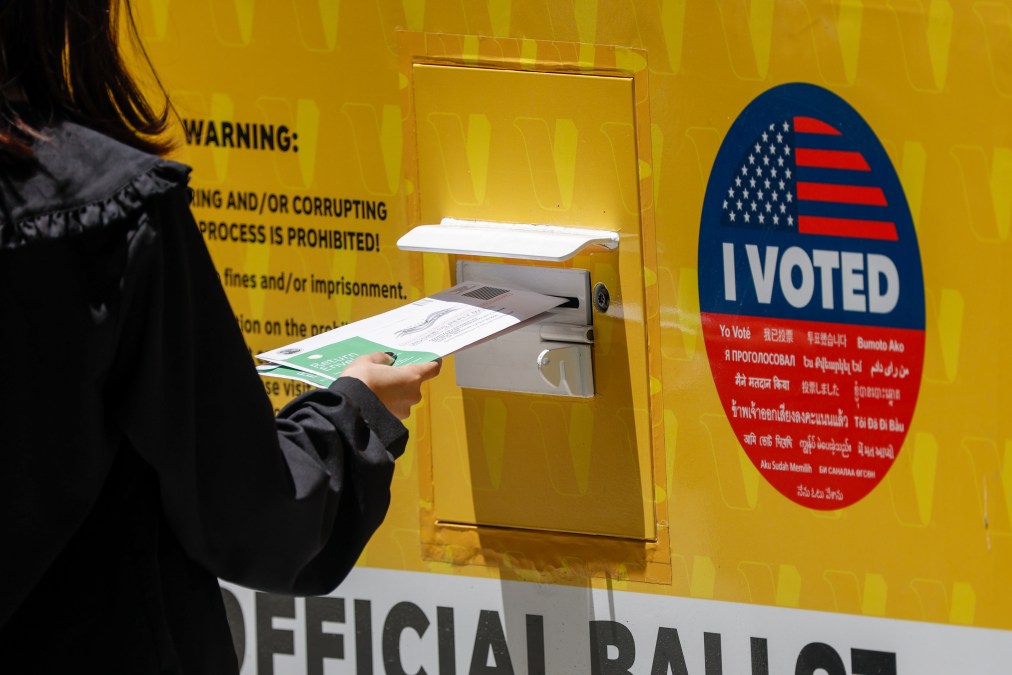
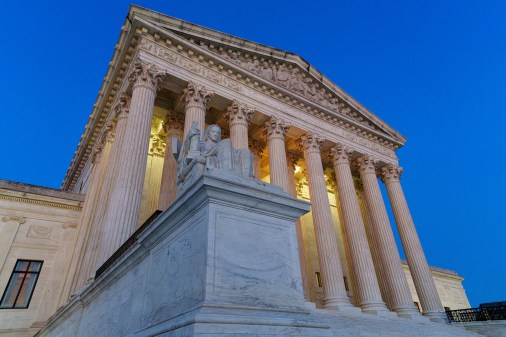
In a 5-4 decision, the Supreme Court upheld the right of states to accept mail-in ballots that are postmarked by Election Day, but can arrive up to five days later through the mail system.
The case stems from a lawsuit brought by the Republican National Committee against Mississippi and its Secretary of State, arguing they could not legally count mail ballots that arrive after Election Day, even if they are postmarked on or before that same day. The RNC argued that federal law defines “elections” and “Election Day” as the casting and receiving of ballots by that day.
Writing for the majority, Justice Amy Coney Barrett rejected that argument, stating that “nothing in the federal Election-Day statutes require ballots to be received by election day.”
“The federal Election-Day statutes do not preempt Mississippi’s law because the defining element of an ‘election’ has always been the electorate’s choice of candidate,” wrote Barrett.
Barrett, joined by Justices John Roberts, Elena Kagan, Sonia Sotomayor and Ketanji Jackson Brown, noted that other federal voting statutes like the Uniformed and Overseas Citizens Absentee Voting Act explicitly say that state law governs when ballots must be received, not the federal government.
Further, while Congress inserted the phrase “Election Day” and specifies it as a Tuesday in its most recent update, it also allows states to modify that period of voting in response to certain force majeure events, like the COVID-19 pandemic.
While the Constitution requires voting to take place by a certain time, the review of those legally cast votes does not need to conclude at the same time.
“The Constitution requires the ‘Day on which [the electors] shall give their Votes’ to be ‘the same throughout the United States,’ but says nothing about the day for receipt,” wrote Barrett. “The Constitution thus envisions a system in which receipt of votes is necessarily divorced from voting. And it sets the crucial, uniform day as the day of voting while leaving receipt to happen later. The federal Election-Day statutes follow the same pattern.”
David Becker, executive director of the Center for Election Innovation and Research, said the ruling upholds the principle that “the election is completed for the voter at the moment they complete their ballot, not the moment that some administrative election official receives that ballot or reviews that ballot.”
It also validates more than a hundred years of state autonomy in setting their own rules regarding the receipt of election ballots.
“This case was about who gets to make that determination,” said Becker. “And as the founders intended, as is clearly laid out in the elections clause of the Constitution, the states get to make that determination about when those ballots should be delivered by the postal service and be counted.”
Still, Becker bemoaned the slow, steady politicization of the issue, and said in conversations many election officials were anxious about the case and relieved to see a victory, albeit a narrow one.
“I’ll be honest with you, in any other era this case should have been a 9-0 [decision],” said Becker. “This is a slam dunk, the states clearly have the authority to do this, they’ve been doing this for decades and decades.”
The ruling likely forecloses major changes to the way states receive or accept mail-in ballots before the midterm elections, but Becker does expect some states to seek legislative changes to align their state laws with the five-day post-election timeline blessed by the court.
14 states and Washington D.C. have state laws that allow any ballot to be received up to five days after Election Day or longer, while more than 30 allow military and overseas ballots to arrive after Election Day. Election experts have said ruling that such ballots were invalid could have upended decades of voting precedent and procedures for American voters at home and abroad.
Michael McNulty, director of Issue One Policy, a nonprofit focused on money in politics and elections, said had the court ruled the other way, it would have created chaos for election administration in more than a dozen states that accept such ballots, forcing them to move ballot receipt deadlines, redesign procedures and conduct large scale voter education campaigns without any additional funding.
The Supreme Court “rightly rejected an attempt to reinterpret federal law to force sweeping last-minute changes to election systems across the country and discard legally cast ballots.”
Pamela Smith, CEO of Verified Voting, a nonprofit focused on promoting secure election technologies, said the ruling should give relief to voters who rely on mail or absentee voting.
“This ruling ensures that a postal delay outside of any voter’s control does not erase a lawfully cast ballot and supports election officials’ ability to capture the will of voters,” said Smith.
Post-election audits and investigations have consistently shown voter fraud in the U.S. is exceedingly rare, and that mail-in ballots are not any more susceptible to fraud than other forms of voting.
Nevertheless, states accepting mail-in ballots past Election Day has been a politically charged subject since the 2020 election, when then-incumbent President Donald Trump was defeated by Joe Biden in part on the strength of late-arriving mail ballots that heavily swung in Biden’s favor.
In the years since, both Trump and the GOP more broadly have cast late arriving mail ballots as inherently suspicious, untrustworthy and opaque.
Those beliefs have persisted.
In their dissent, Justices Samuel Alito, Neil Gorsuch, Clarence Thomas and Brett Kavanaugh wrote that the decision “leaves open opportunities for voter fraud that may further undermine Americans’ faith in the integrity of this country’s elections.”
“Mail voting also presents a greater opportunity for voter manipulation, a more vulnerable chain of ballot custody, and a diminished ability to detect improprieties in real time,” Alito wrote on behalf of the minority. “Today’s decision compounds these vulnerabilities. Allowing absentee ballots to pour in over the days and weeks after election day, by which point preliminary election returns are being publicly reported, creates greater opportunity for fraud and risks further undermining the public’s confidence in election integrity.”