SCOTUS tosses one of two injunctions against Trump USPS mail-in ballot rules
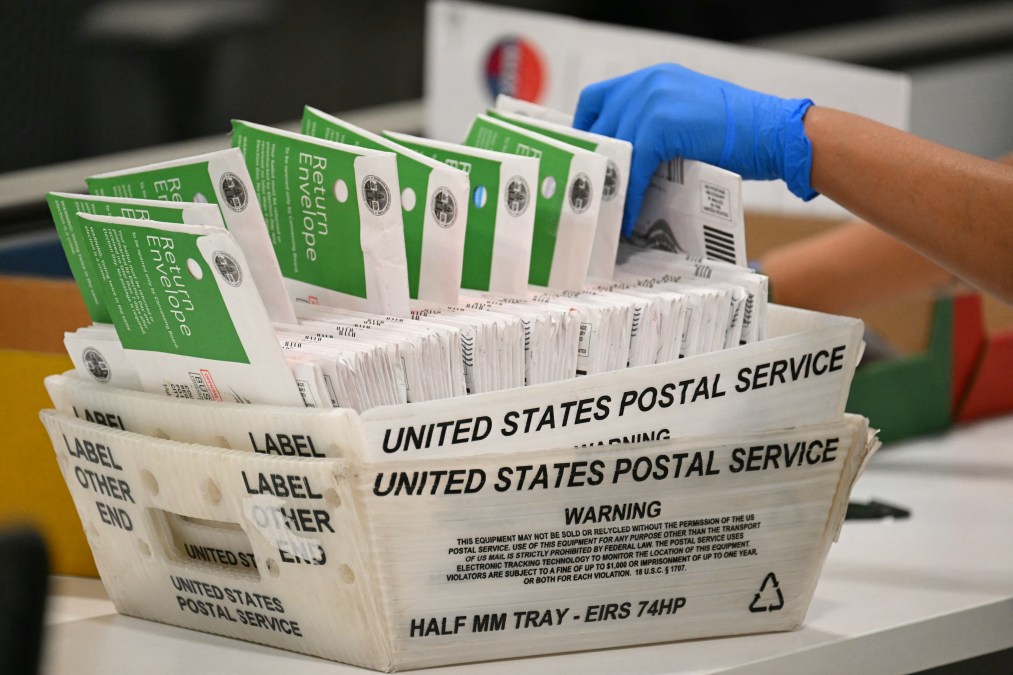
The Supreme Court dismissed one of two lawsuits blocking the Trump administration from implementing changes to U.S. Postal Service regulations regarding mail-in ballots, saying that states lacked standing because they could not prove that the regulations would cause “concrete harm.”
California and 23 other states sued the federal government after a White House executive order directed USPS to begin creating “State Citizenship Lists” for each state, consisting of voters who, according to federal data, are eligible to receive mail-in ballots.
The order states that the lists will be updated and transmitted to states 60 days before the election, and states that “An individual’s identification on the State Citizenship List does not indicate that the individual has been properly registered to vote in the State” and that “there may be State laws, not reflected in the State Citizenship List, that preclude voter registration, or the individual may choose not to be registered.”
That provision was thrown out by two federal courts, who found them unconstitutional and likely to result in the federal government intruding on the constitutional rights of states to run their elections.
But the Supreme Court’s conservative majority voted 6-3 to dismiss the lawsuit, saying that states have no standing to sue because “The Order is an internal directive from the President to his subordinates mandating that certain agencies pursue certain policies” and the order “neither requires nor forbids anything of anyone outside the executive branch.”
Because the section of the order is prefaced to say that the Secretary of Homeland Security will transmit the lists “to the extent feasible and consistent with applicable law,” the majority said the claims of harm by states are, at this point, entirely speculative.
“The true ‘source of any injury’ to the States would be the downstream action that the Secretary ‘might take in the future’ to implement” the USPS sections,” the court wrote. “Emphasis on might.”
At the same time, another section directs the Department of Justice to prioritize investigation and prosecution of state and local election officials who “knowingly” allow instances of non-citizen voting.
The majority argued the DOJ directive was internal guidance that neither regulated states’ voter registration nor limited states’ authority to set their own election rules. Since it only prioritized enforcement of existing laws, the court said it did “nothing” to states.
“The States lack standing to challenge for much the same reason: It does nothing to them,” the majority wrote. “This provision directs the Attorney General to ‘prioritize’ the investigation and prosecution of those who violate existing federal laws by issuing ballots to ineligible voters.”
The USPS regulations remain blocked under a separate injunction issued by federal court in Massachusetts, but the ruling demonstrates there are major differences between the Supreme Court majority and lower federal courts on the Trump administration’s years-long effort to assert more federal control over elections. On Friday, USPS moved to finalize the new regulations despite the nationwide injunction.
The three remaining liberal justices – Elena Kagan, Sonia Sotomayor and Kentaji Brown Jackson – laid out their opposition to the ruling across two dissenting opinions. In one, Sotomayor and Kagan wrote that the majority’s decision “merely postpones adjudication” and does not address or rule in favor of the administration on many substantive constitutional questions.
Both would have granted relief to the states, writing that “a commonsense reading of the executive order, corroborated by the government’s own representations, make clear that the respondent states face a sufficiently concrete and imminent injury.”
Sotomayor also expressed incredulity at the majority’s view that the order’s sections on USPS state citizenship lists and directing DOJ to prosecute election officials were unrelated or nonthreatening.
“To pretend that the lists assembled [in one section] bear no relation to the prosecutions directed by [the second section] is to ignore the structure of the Executive Order and the Government’s words alike,” she wrote. “As this Court has long recognized, ‘[p]eople do not lightly disregard public officers’ thinly veiled threats to institute criminal proceedings against them if they do not come around.”
Justice Jackson, in her own dissent, was even blunter.
“The District Court held that the President’s Order is unlawful, the Government does not defend the lawfulness of the Order before this Court, and no judge or Justice has held (or holds today) that the Order comports with the Constitution,” wrote Jackson. “Still, the Court sees fit to grant the Government equitable relief to proceed with implementing the challenged Order on the grounds that, because the Government had not yet issued a final rule at the time the complaint was filed, the Plaintiff States lacked a concrete injury for Article III purposes.”