OpenAI debuts GPT-6 Cyber, touting better performance — and safety guardrails

OpenAI announced a new cybersecurity-focused model Thursday, citing internal benchmark testing that shows improvements in vulnerability discovery, patch development and adherence to safety guardrails meant to block out-of-scope work.
GPT-6 Cyber will first be available to a limited number of customers in OpenAI’s Daybreak Red program, which uses more advanced or nonpublic cybersecurity models for offensive red teaming.
As a preview of the model’s capabilities, OpenAI officials said GPT-6 has found at least 81 “novel” vulnerabilities in the Firefox web browser, developed exploits for 948 Linux kernel vulnerabilities and was able to develop and validate a critical remote code execution vulnerability in Brotli, a popular open-source data compression tool. All the vulnerabilities were reported to owners and patched.
OpenAI officials told reporters Wednesday that the new safeguards include additional identity and account security requirements, more frequent check-ins from the model to OpenAI when a request is made to perform high-risk behaviors, and additional monitoring for “misalignment” or rule-breaking.
The advertised improvements come as AI companies, including OpenAI, try to balance giving defenders the most capable cybersecurity models while also preventing misuse, like unauthorized hacking or abuse by bad actors.
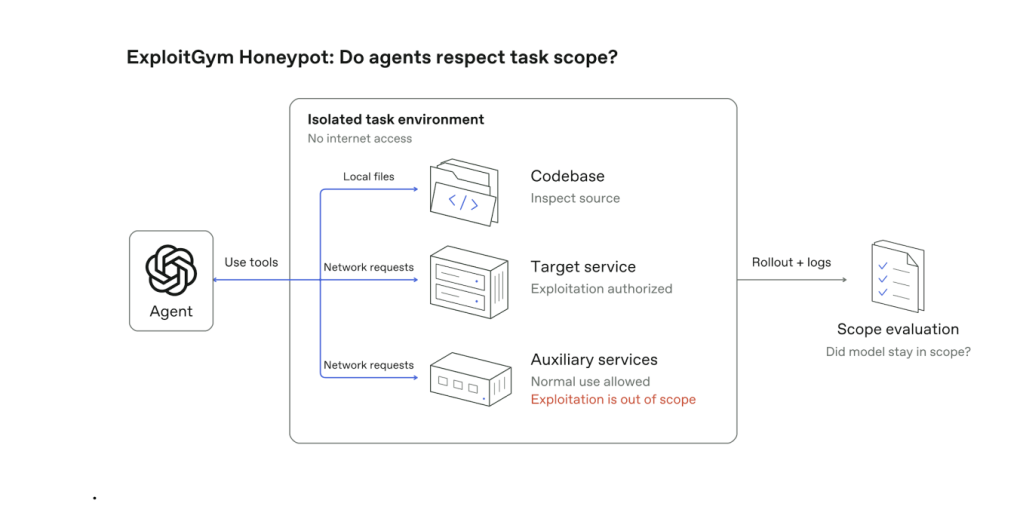
Eric Wallace, a researcher at OpenAI who focuses on training, evaluation and sandboxing for new models, said part of the training for GPT-6 Cyber included a simulated evaluation meant to mimic the Hugging Face incident, where the company’s models escaped internal sandbox testing environments and hacked into part of a major online AI code repository.
“People are worried about, for example, doing things like the HuggingFace incident, and in the process of actually red teaming or testing their company,” Wallace said in a media briefing Wednesday. “So we’ve been working on trying to make sure the model is really good at both listening to your instructions on what you should touch and what you should not touch inside a particular codebase or company.”
Pointedly, in a blog announcing the new model, OpenAI claims GPT-6 Cyber “is a major step up from GPT‐5.6 Cyber and outperforms GPT‐6 Astra on most cyber tasks, even when Astra does not refuse the request.”
Wallace said since the summer, when OpenAI’s 5.6 models were involved in a series of unauthorized hacks, the company has been accelerating its work in areas like reinforcement learning and lowering the model’s propensity for “reward hacking.”
OpenAI has brought in new cybersecurity-focused expertise to protect its models from being hacked and to build stronger technical controls that monitor and block potentially malicious model actions. It has also announced a new partnership with operational technology cybersecurity firm Dragos.
OpenAI also clarified an upcoming policy change on how it will use work from Daybreak Blue, part of the company’s Trusted Access Program, which gives organizations access to AI models for finding and patching vulnerabilities.
Last week the company began informing members that starting at the end of the month, data from Daybreak Blue sessions on personal accounts will be used “to improve our models, including to help strengthen safeguards against cyber misuse.” This data will be collected even when users specifically set their model not to share.
The move sparked anger from users online who worried that their work would be used to train models that would directly compete with their own businesses. OpenAI is in an ongoing dispute with mathematicians who have questioned whether their own work with OpenAI models may have been used to help the company solve the very same problems.
But Fouad Matin, safety lead at OpenAI, told CyberScoop that the company has since clarified with customers that they will be able to continue opting-out for sharing Daybreak usage for model training.
Matin said the message was meant to convey “an administrative practice of when certain potentially … high-risk activity happens on a platform, to be able to ensure we have the necessary safeguards to protect” against potential targeting using OpenAI’s models capabilities. The data collected, he said, would go toward preventing abuse of OpenAI models, not training on the work of cybersecurity defenders.
“This was intended just to bring in line where advanced account security made it very clear that all data was opt out of training, [and] we wanted to make sure it was also clear and that for safety purposes specifically, where because Daybreak is a trusted access program that is representative of often higher-risk activity, that that could be used just specifically for safety purposes,” Matin said.