Supply chain challenges loom large in quantum race, White House official says

One of the most difficult obstacles to overcome in the quantum race will be the supply chain, given how diffuse it is, a top White House official said Wednesday.
“Supply chain is one of the biggest challenges in my mind, and really, the challenge with the quantum supply chain is that quantum is not defined by a single hardware platform,” said Brad Blakestad, director of the National Quantum Coordination Office within the White House Office of Science and Technology Policy.
“If you look at the quantum computing technologies, the quantum sensing technologies, the networking — those are all different,” he said in a webinar hosted by Inside Cybersecurity and USTelecom. “And even within computing, there’s seven different modalities that use completely different components. So we have this not just one monolithic supply chain, but just a bunch of different supply chains that are kind of intertwined in various ways.”
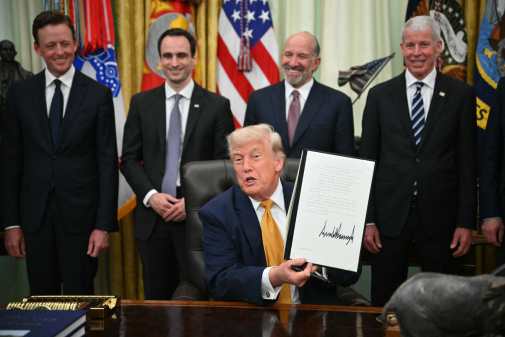
Blakestad made his remarks a little more than a month after President Donald Trump signed two executive orders on quantum computing. He referenced proposed ways to address the supply chain challenge in one of the orders.
“The other major issue or challenge that we face right now is that we’re on the cusp of quantum exploding from a commercialization perspective, but we’re not quite there yet,” he said. “So there’s not the funding, the revenue coming from large-scale quantum companies at this point to really make the supply chain as robust as you would want. So thinking about it from the government perspective, it’s just [that] there are too many places that I would want to bolster and not enough funding to do it.”
Blakestad touted steps to help that along such as the government buying widgets from a company that makes them to certain specifications, or prize challenges.
The quantum supply chain isn’t just diffuse in the United States, an International Institute for Strategic Studies policy paper noted Wednesday. It’s “inherently international: no single country dominates the supply chain, whether specialised materials, cryogenic equipment, hardware, software, fabrication or algorithms,” the authors, Dongyoun Cho and Maria Shagina, wrote.
And a March report from the Center for a New American Security identified strengthening the quantum supply chain as pivotal to the United States seizing the benefits of the technology, citing gaps in the U.S. supply chain and reliance on foreign suppliers such as China and Russia.
Supply chain wasn’t the only obstacle Blakestad mentioned as looming large.
“The encryption challenge is a real challenge, and we want to make sure that we are aware of when quantum computers will ultimately get to a scale that they start having these sorts of implications and move as quickly as we can,” he said. “So, just by owning the technologies, by owning the workforce, by making the United States the place that people want to come to be on the cutting edge of this technology, I think that kind of addresses both of those issues, and that’s what makes it so critical.”
Another difficulty is measuring progress, Blakestad said: “It’s also very, very hard to benchmark, and to know that you’re actually doing what you’re supposed to, what you are intending to do.”