Federal court tosses Trump lawsuit challenging Alaska Senate certification
A federal judge dismissed a lawsuit from the federal government seeking to preemptively block Democratic Senate candidate Mary Peltola from assuming office if she wins her race.
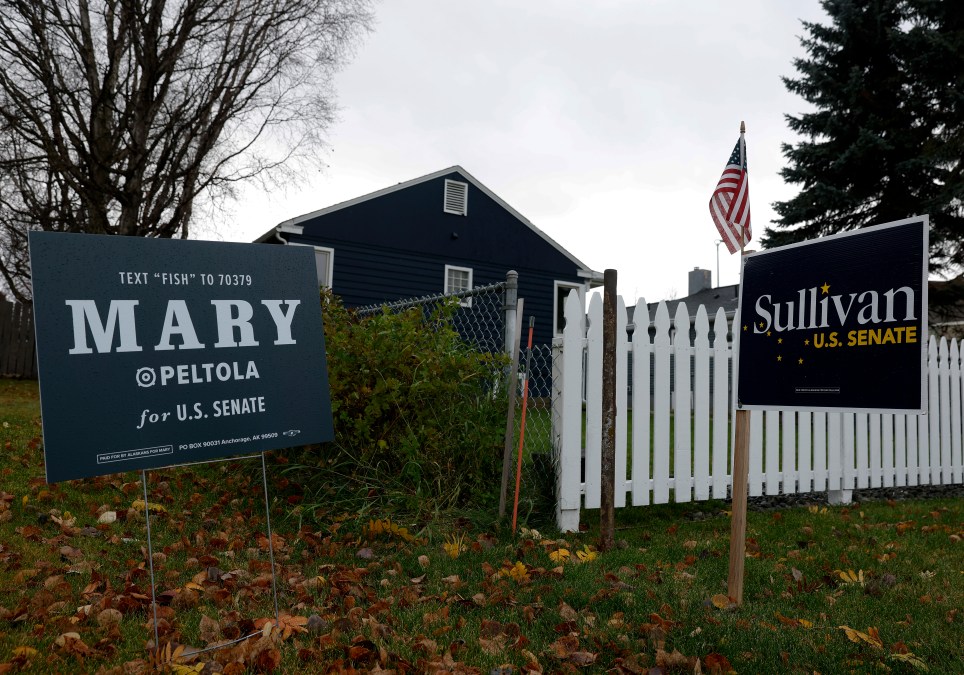
The Department of Justice sued Alaska last month, arguing that an alleged scheme by Peltola to recruit Daniel J. Sullivan, an independent candidate who shares a name with incumbent Republican Sen. Dan S. Sullivan, would confuse voters.
Peltola’s campaign, the Democratic Senate Campaign Committee and civic groups including the League of Women Voters of Alaska and Common Cause all filed motions to dismiss the lawsuit, arguing the federal government lacks standing and constitutional authority to weigh in on Alaska’s elections.
They also said the court cannot grant relief because there is no legal way to determine whether a voter mistakenly voted for one Sullivan over the other without violating the secret ballot.
U.S. District Judge Sharon Gleason reached the same conclusion, noting in an order “the absence of any explanation from the United States as to how its requested relief could redress its alleged injury while simultaneously maintaining the secrecy of the ballot.” She also wrote that she “cannot grant the United States the relief it seeks because the United States has failed to establish the redressability prerequisite for Article III standing.”
Gleason’s opinion recounts Daniel J. Sullivan’s independent candidacy. Alaska Director of Elections Carol Beecher decertified it in June, later testifying that she did not believe he was running in good faith. State courts disagreed and restored his candidacy, and the Alaska Supreme Court upheld that ruling.
Alaskan election officials still took steps to distinguish the two candidates, listing their full names and labeling them “Incumbent,” “Republican candidate” and “Independent.” Alaska’s ranked-choice system lets voters rank both Sullivans, so they are not limited to a single candidate.
State officials and election experts also noted that nearly 60,000 Alaskan voters have already cast early or mail ballots, and there is no feasible way to reissue them.
The government’s one-sentence response said the state could segregate ballots and asked the court to allow a federal investigation into whether any voters were deceived. Gleason rejected that approach, saying the government offered no explanation of how ballot segregation or a law enforcement inquiry into voters’ intent could be carried out while preserving ballot secrecy.
Gleason also questioned the government’s constitutional basis, writing that the executive branch has no legitimate role in determining which candidates appear on Alaska’s ballots. The government said it was not seeking to change the time, place or manner of the election, but Gleason noted that its requests, including limits on certification, ballot segregation and an investigation of voters’ intent, all concern those matters, which are the state’s responsibility.
The lawsuit drew heavy media attention and concern from democracy advocates, but legal experts widely viewed it as exceptionally weak.
“Today’s ruling marks a victory for Alaska state sovereignty and Alaskan voters,” said David Becker, executive director of the nonprofit Center for Election Innovation and Research and a former voting rights attorney at DOJ. “By soundly rejecting the administration’s unlawful and now unsuccessful attempt to interfere, the court concurred with the State of Alaska that this is purely a matter of state law and that, under the U.S. Constitution, the federal government has no role in determining how Alaska certifies its Senate election.”