Wyden warns Social Security chief: Trump’s voter database is ‘blatant voter suppression’

Sen. Ron Wyden, D-Ore., warned Social Security Administration chief Frank Bisignano that any follow-through on President Donald Trump’s executive order creating a new database of U.S. voters using agency data would be viewed by Democrats as a conscious choice on the part of SSA officials to participate in “blatant voter suppression.”
“Facilitating Donald Trump’s directive to create a flawed voter database would be willing participation in blatant voter suppression ahead of consequential midterm elections,” Wyden, the top Democrat on the Senate Finance Committee, wrote in a letter to Bisignano sent Friday.
The executive order, issued March 31, directs the Homeland Security secretary, the director of U.S. Citizenship and Immigration Services and the commissioner of the Social Security Administration to compile lists of American voters for each state, including their supposed citizenship status.
To build the lists, the agencies would rely on the controversial Systematic Alien Verification for Entitlements database that DHS has been building under the Trump administration, as well as Social Security and federal citizenship and naturalization records.
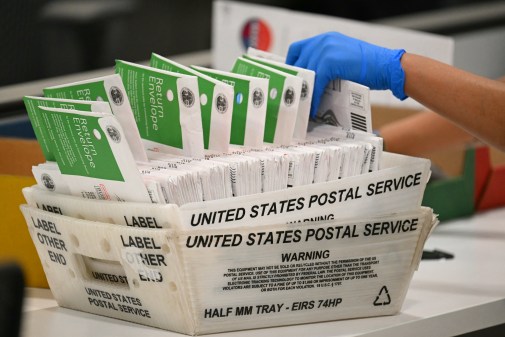
Those lists would then be transmitted to states, most of which have already rejected previous Trump administration efforts to collect voter data or dictate voter registration lists. Another section of the order would direct the postmaster general to develop a similar state-by-state list of voters eligible to vote by mail.
“The clear intent of this executive order is to undermine vote-by-mail and disenfranchise eligible voters,” Wyden wrote. “SSA has a duty to ensure its data is not misused as part of this effort.”
Wyden echoed numerous state officials and election experts in calling the Trump administration’s executive order an unconstitutional encroachment by the executive branch on election authorities that the U.S. Constitution clearly delineates to Congress and the states.
The White House’s executive order has already been challenged in lawsuits from states officials and voting rights advocates, and a previous, less ambitious executive order issued last year that attempted to assert similar executive branch authorities was largely overturned by U.S. courts.
Wyden’s missive essentially asks Bisignano to consider whether following the Trump administration’s order would conflict with his responsibility to safeguard Social Security records under laws like the Privacy Act and the Social Security Act.
He asks how the agency will ensure it’s not disenfranchising voters, and whether it sought permission from citizens to use their Social Security data for a federal elections list, noting that the agency’s own regulations limit the sharing of Social Security data to “routine use for determining eligibility or amount of benefit in a health or income maintenance program.”
Expanding the agency’s role to elections — an area it has no background or experience in — would be in direct conflict with those rules.
“Simply put, sharing Americans’ personal data to DHS for creating a ‘state citizenship’ list does not meet this standard,” Wyden wrote.