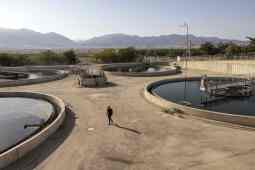
Arik Ashkenazi, chief engineer at the Ein Netafim wastewater treatment plant, walks between water clarifier basins at the facility in Israel’s southern Red Sea port city of Eilat on July 13, 2023. Hemmed in between the Red Sea and a desert, isolated from the rest of Israel and with no natural freshwater, Eilat’s drinking water is a combination of desalinated groundwater and sea water. After its domestic use turns it into sewage, it is treated and then allocated to farmers, enabling the arid region to support an agricultural industry. While Eilat used to be the exception in Israel’s water management, it is now more of a prototype for the country and perhaps to the world. (Photo by MENAHEM KAHANA / AFP) (Photo by MENAHEM KAHANA/AFP via Getty Images)
Censys researchers warned that thousands of devices are exposed to the Iranian government’s campaign targeting energy, water, and U.S. government services and facilities.
Wind turbines are seen on a wind farm on a field between agricultural produce in a countryside in a village near Radom, Poland on May 19, 2025. (Photo by Dominika Zarzycka/NurPhoto)
The Cybersecurity and Infrastructure Security Agency said the attack highlighted threats from vulnerable edge devices to operational technology and industrial control systems.
A laparoscopic surgical robot demonstrates grasping rose petals during the third phase of the 138th edition of the China Import and Export Fair (Canton Fair) at the Canton Fair Complex on Nov. 1, 2025 in Guangzhou, Guangdong Province of China. A Commerce Department office should investigate Chinese government-connected products in more than a dozen emerging industries for security threats, a group of House GOP committee leaders said in a letter they released Wednesday. (Photo by Huang Taiming/VCG via Getty Images)
Bulazel mentioned the energy sector in particular, given the potential for hackers to turn off the power in the United States. It’s a sector that relies in large measure on supervisory control and data acquisition (SCADA) systems to monitor and control industrial processes. (Image Credit: AndreyPopov via Getty Images)
Attacks on industrial organizations soared by 87% last year, while the number of ransomware groups impacting the OT/ICS space jumped 60%, according to cybersecurity firm Dragos. (Image Source: Getty Images)
States are increasingly collaborating with cybercriminal groups to share resources and amplify attacks on critical infrastructure in rival nations, a new report finds.
Other sectors that the hacktivists — who sometimes pose physical threats — are targeting in North America and Europe include energy and agriculture, according to a Wednesday…