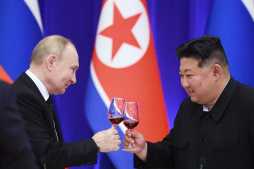
In this pool photograph distributed by the Russian state agency Sputnik, Russian President Vladimir Putin and North Korean leader Kim Jong Un toast during a reception at the Mongnangwan Reception House in Pyongyang on June 19, 2024. Putin enjoyed a red carpet welcome, a military ceremony and an embrace from North Korea’s Kim Jong Un during a state visit to Pyongyang where they both pledged to forge closer ties. (Photo by Vladimir Smirnov / POOL / AFP via Getty Images)
DTEX researchers found a series of transactions in a payment wallet showing North Korean IT worker salaries flowing into sanctioned entities that support the regime’s military programs.
The men facilitated about $1.28 million in salary from victim U.S. companies by hosting laptop farms and helping remote IT workers assume fake identities.
Attackers have turned AI into a “force multiplier” for the country’s expansive scheme to get and keep operatives hired at global companies, researchers said.
Oleksandr Didenko ran laptop farms and provided forged or stolen identities to North Korean operatives who gained remote employment at 40 U.S. businesses.
Federal prosecutors secured five guilty pleas from people who supported overseas remote IT workers, and seized $15 million in stolen cryptocurrency tied to the North Korean regime.
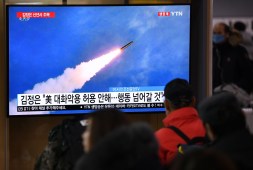
People watch a television news programme showing file footage of North Korea’s missile test, at a railway station in Seoul on Jan. 1, 2020. (Photo by JUNG YEON-JE/AFP via Getty Images)
The Treasury Department on Tuesday sanctioned eight people and two companies it accused of laundering money obtained from cybercrime and IT worker schemes to fund North Korean…
Okta Threat Intelligence uncovered a large-scale and sustained operation, reflecting the North Korean regime’s pursuit of any opportunity that allows for remote employment.