The Republican lawmaker called OpenAI’s leadership decisions “reckless,” and used recent warnings about the existential risk of AI to bolster his inquiry.
The company says the breach stemmed from a systemic failure of alignment and security, and has taken measures to prevent agents from independently orchestrating complex cyberattacks.
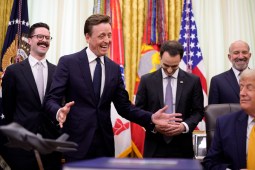
United States National Cyber Director Sean Cairncross (2nd-L) accompanied by United States Chief Technology Officer Dr. Ethan Klein (L), White House Office of Science and Technology Policy Director Michael Kratsios (3rd-L), U.S. President Donald Trump (R), and Commerce Secretary Howard Lutnick (2nd-R), speaks during an event in the Oval Office of the White House on June 22, 2026 in Washington, D.C. (Photo by Andrew Harnik/Getty Images)
The Trump administration executive order on artificial intelligence tried to strike the balance between responsible use, security and mutual benefit, all with an eye toward not making…
U.S. Sen. Kirsten Gillibrand, D-N.Y., attends a subcommittee hearing with the Senate Committee on Appropriations in the Dirksen Senate Office Building on April 22, 2026. (Photo by Anna Moneymaker/Getty Images)
The OpenAI logo is displayed on a smartphone screen placed on a reflective surface, photographed using a slow exposure with a motion blur effect, in Creteil, France, on May 12, 2026. Daybreak is an AI-powered cybersecurity service designed to detect, analyze, and remediate software vulnerabilities more quickly. (Photo by Samuel Boivin/NurPhoto via Getty Images)
We almost never get both sides of an intrusion. This time we did. Last month, Hugging Face disclosed a breach into part of its production infrastructure, saying…
The Hugging Face breach shows there is a gap in federal policy. The frameworks to govern autonomous AI already exist—there just needs to be the desire to…