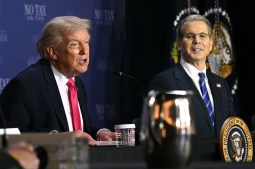
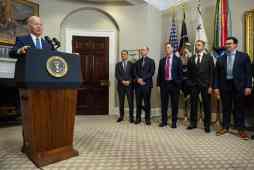
US President Donald Trump (L) speaks, flanked by US Secretary of Treasury Scott Bessent, during a roundtable discussion on his “no tax on tips” policy at the AC Hotel Las Vegas Symphony Park in Las Vegas, Nevada, on April 16, 2026. (Photo by Jim WATSON / AFP via Getty Images)
The government's new AI clearinghouse risks becoming a committee that discovers more problems than it solves — unless it's designed around patching, not just scanning.
The order — which Trump previously refrained from signing at the last minute — appears to make significant concessions to industry compared to earlier drafts.
US President Donald Trump (L) speaks, flanked by US Secretary of Treasury Scott Bessent, during a roundtable discussion on his “no tax on tips” policy at the AC Hotel Las Vegas Symphony Park in Las Vegas, Nevada, on April 16, 2026. (Photo by Jim WATSON / AFP via Getty Images)
Under a draft executive order, the NSA, Treasury Department and other federal agencies would get 90-days to test new models for cybersecurity and national security concerns.
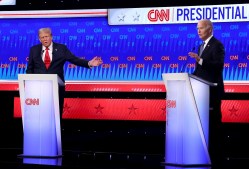
U.S. President Joe Biden and then-Republican presidential candidate, former U.S. President Donald Trump, participate in the CNN Presidential Debate at the CNN Studios on June 27. (Photo by Justin Sullivan/Getty Images)
Brandon Wales, then-Acting Director Cybersecurity and Information Security Agency at U.S. Department of Homeland Security speaks during a Senate Homeland Security and Governmental Affairs Committee hearing May 11, 2021 on Capitol Hill. (Photo by Tasos Katopodis-Pool/Getty Images)
President Joe Biden speaks about artificial intelligence at the White House after meeting with several AI and tech executives on July 21, 2023.(Photo by Andrew Caballero-Reynolds/AFP via Getty Images)
Long-awaited EO attempts to toe the line between harnessing artificial intelligence’s vast capabilities and protecting “Americans from the potential risks of AI systems.”